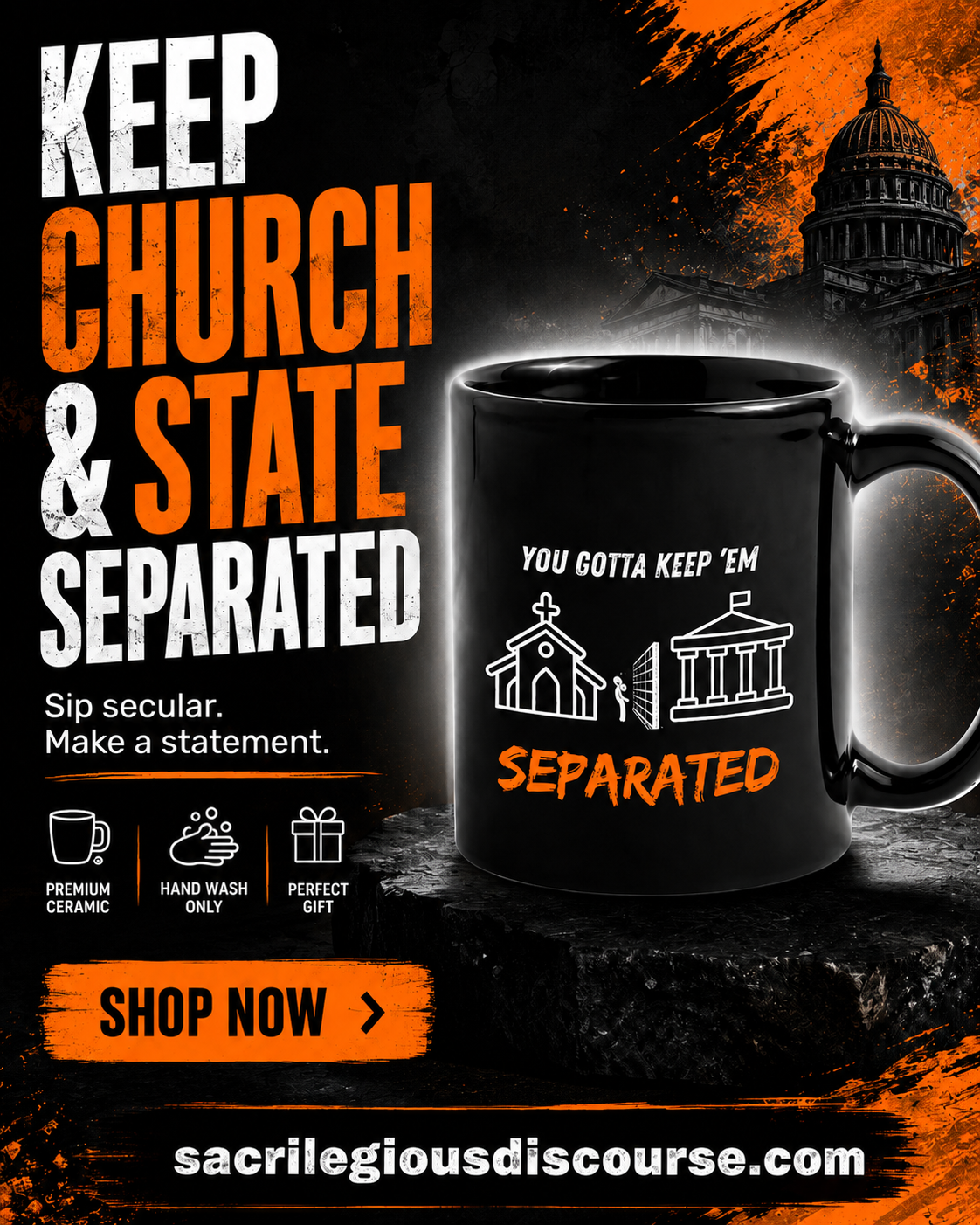
Sacrilegious Discourse is an atheist Bible study podcast hosted by a married couple known as Husband and Wife, two lifelong non-believers living in the Midwest who decided to actually read the Bible, every chapter, and talk about it out loud. What started as a personal skeptical project has grown into one of the most thorough secular commentaries on scripture available anywhere: more than 1,300 episodes, millions of downloads, and a community of atheists, agnostics, ex-Christians, and curious secular listeners who keep coming back because the show never talks down to its audience.
What Sacrilegious Discourse Is
This is not a podcast that dunks on religion from a distance. Husband and Wife actually read the text, Genesis to Revelation, chapter by chapter, and engage with it seriously as a subject worth understanding. They bring secular commentary, skeptical analysis, and a willingness to sit with the hard questions that the Bible raises: the violence, the contradictions, the historical context, the apologetics, and the human story underneath all of it.
The result is something that works for a lot of different listeners. If you grew up in a religious household and are still processing what you were taught, the show gives you a structured, irreverent companion for that work. If you've been secular your whole life and simply want to understand what the Bible actually says, rather than what people claim it says, this is the most complete atheist read-through available. And if you're somewhere in the middle, still figuring it out, you're welcome here too.
Alongside the main episode archive, the site includes a secular commentary blog, a curated Reference Library of academic and scientific resources, a Bible Contradictions database, a Church-State Action Center, and a secular events directory. It's built to be more than a podcast: it's a resource for people who take the secular perspective seriously.
The Hosts
Husband
Husband is the show's primary skeptic and the one most likely to pull the thread on an inconsistency until it fully unravels. He identifies as atheist (not agnostic, not "spiritual but not religious," not hedging) and brings a direct, no-nonsense perspective to the text. His approach to the Bible is the same one he'd bring to any other ancient document: read it carefully, question the claims, follow the evidence. He grew up surrounded by Christianity in the Midwest, which means he understands the cultural weight of the religion even as he rejects its truth claims. That context shapes how the show engages with believers, never dismissively and always directly.
Wife
Wife leans agnostic but mostly atheist: she's been clear that she's not waiting for evidence that might change her mind so much as she's honest about the limits of certainty. She brings a different texture to the show: more likely to linger on the human dimensions of the text, to ask what people were actually trying to do when they wrote this, and to notice the moments where the Bible says something genuinely interesting before dismantling it. Together, the two of them create a dynamic that keeps the show from being a monotone argument: there's real conversation happening, not just two people agreeing with each other for an hour.
Why Atheist Bible Study?
Most people who grow up secular in the United States never actually read the Bible. They absorb fragments of it, like the verse someone quotes at them, the story from a Sunday school memory, the passage deployed in a political argument, but they rarely have the full picture. That's a disadvantage. Understanding what the Bible says, how it's structured, where it contradicts itself, what it meant in historical context, and how modern believers interpret it is genuinely useful knowledge for anyone navigating a country where religion shapes policy, culture, and daily life.
Atheist Bible study matters because the Bible is too culturally influential to remain unexamined. Sacrilegious Discourse makes that examination accessible: long-form enough to be thorough, conversational enough to be enjoyable, and secular enough to call it what it is when the text does something strange. The show has found its audience among atheists and agnostics who want the full read, ex-Christians who are revisiting what they were taught, and secular people who simply want to be informed. It ranks consistently in the top 5% of all podcasts across every genre.
What You'll Find Here
The episode archive covers the entire Bible in sequence, spanning more than 1,300 episodes working from Genesis through the New Testament, with Q&A episodes woven in after major sections. Each episode is a real read-through: Husband and Wife go chapter by chapter, quote the text, and respond to it in real time. Browse the full episode archive.
The blog expands on episodes with written analysis, current events commentary, and secular essays that go deeper than the podcast format allows. The Reference Library is a curated research index organized into categories (biblical scholarship, secular philosophy, science, counter-apologetics, church-state law, and more), built to support both casual curiosity and serious research. The Bible Contradictions database is a structured, searchable index of scriptural inconsistencies, built from the show's episode notes over years of close reading.
For listeners who want more than listening, there's an active Discord community for live episode discussions, a Patreon for supporters, and a Church-State Action Center that tracks legislation and connects secular advocates with resources for pushing back on religious overreach.
Where to Listen
Sacrilegious Discourse is available on every major podcast platform. Find it on Apple Podcasts, Spotify, YouTube, and via RSS or any podcast app. New episodes drop regularly, so follow the show on your platform of choice so you don't miss them.
If you're new, the Start Here page will point you in the right direction depending on where you are and what you're looking for.