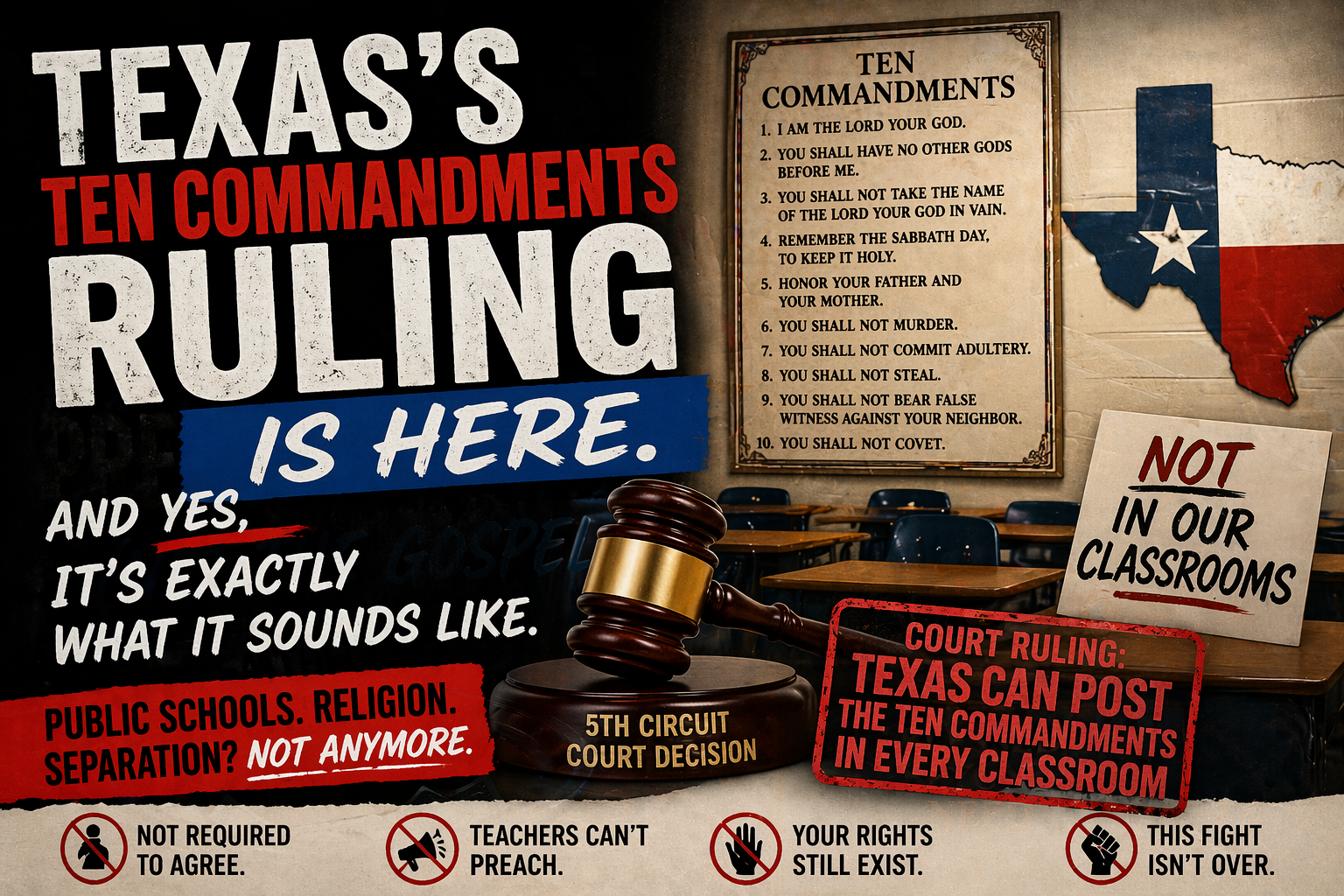
Texas’s Ten Commandments Ruling is here, and it is exactly what it sounds like: a federal appeals court said Texas can make every public-school classroom hang the Ten Commandments. If you’re a parent, teacher, or atheist advocate wondering what just happened and what to do next, here’s the no-BS version.
What the court decided
The U.S. Court of Appeals for the Fifth Circuit upheld a Texas law requiring every public-school classroom to post the Ten Commandments. That’s according to Associated Press reporting at PBS NewsHour, and it matches what a coalition led by the ACLU says about the ruling. The case involves a multifaith group of Texas families, including clergy, who sued their districts to stop the mandate. Major outlets, like the New York Times, are already flagging the national stakes.
So what does the law actually require?
In short: a Ten Commandments poster in every classroom. The details on size or wording come from the statute, but the bottom line is the same everywhere: public schools must put a specific religious code on the wall. This is not a neutral history exhibit. It is the Decalogue, presented as such.
Why this clashes with the First Amendment
For decades, the Supreme Court said public schools cannot post the Ten Commandments as a classroom fixture. In 1980, the Court struck down a similar Kentucky law because it endorsed religion. More recently, the Court changed how it analyzes Establishment Clause cases and talks more about “history and tradition.” The Fifth Circuit leaned into that newer framing to say Texas can do this.
Groups challenging the law call the ruling a break from basic church-state separation. The ACLU-led plaintiffs say it violates fundamental First Amendment principles and conflicts with binding Supreme Court precedent. Translation: this is far from settled, and it could head to the Supreme Court.
What this means for your kid’s classroom
Putting a Ten Commandments poster on the wall does not give teachers a license to preach. Here’s what changes and what doesn’t:
- The poster must go up. Schools will be scrambling to comply. Expect awkward emails and invoices for new signs.
- Your child does not have to read, recite, agree with, or face discipline for ignoring the poster. Passive exposure is what the court allowed, not religious coercion.
- Teacher-led religious activity is still off-limits. A teacher cannot use the poster to pressure students to worship, confess, or adopt specific beliefs.
- Student speech rights still exist. Students can express disagreement in non-disruptive ways, like wearing a T-shirt, writing an op-ed in the school paper, or opting out of any assignment that crosses from “about religion” to “practice religion.”
What you can do this week
- Document everything. Save emails and take time-stamped photos of classroom displays once they appear. Note if teachers or staff use the poster to push religion.
- Set expectations early. Politely tell your principal and teachers that your family expects a religiously neutral classroom. Keep it short, written, and calm.
- Report problems. If there’s proselytizing, prayer led by staff, or punishment for dissent, contact the ACLU/AU/FFRF coalition listed here. They are coordinating the litigation and want facts.
- Coordinate with other parents. Multifaith coalitions matter. The current plaintiffs include families from different religious backgrounds, which strengthens the case that this is government favoritism, not “neutral tradition.”
- Talk to your school board. Ask for clear staff guidance: the poster is not a teaching prompt, not a devotional, and not a classroom rule.
Likely next steps in court
The families challenging the law can ask the full Fifth Circuit to rehear the case and then go to the Supreme Court. The ACLU statement makes it clear they are not done. However this moves, the stakes are national. If this stands, expect copycat laws. That’s why outlets like the New York Times and the AP via PBS are all over it.
Talking points for school board meetings
- Neutrality, not hostility. Public schools should not endorse any religion. That protects believers and nonbelievers alike.
- Classroom time is precious. Math and literacy scores need help. A government-mandated religious sign does not teach a kid to read.
- Real diversity. Texas classrooms include Christians, Jews, Muslims, Hindus, Buddhists, Sikhs, atheists, and more. A single religious code on the wall tells some kids they don’t belong.
- Legal risk. Any staff-led preaching or discipline tied to the poster will trigger lawsuits you will lose.
For religious readers who dislike this too
You’re not alone. The plaintiffs include clergy and religious families who do not want the state deciding whose scripture goes on their kids’ walls. As the ACLU press release notes, this is a multifaith pushback against government favoritism.
The bottom line
The Fifth Circuit just invited Texas to put a specific religious code in every classroom. That does not give schools permission to preach, punish, or pick winners among faiths. Keep receipts, set boundaries, and support the families dragging this back to court. This fight is not over.
FAQ
No. The ruling allows a passive display on the wall. Your child does not have to read, recite, endorse, or interact with it, and they should not be punished for ignoring it.
No. Even with the poster up, staff-led religious activity or pressure on students to adopt religious beliefs remains unconstitutional.
Document the incident, save communications, and contact the organizations coordinating the challenge, such as those listed in the ACLU’s press release linked above.
Yes. The challengers can seek further review. The ACLU and partner groups indicate the litigation will continue, and the issue could reach the Supreme Court.
Schools control their walls, but adding more scripture does not fix the endorsement problem. The safer move is clear staff guidance not to use the poster devotionally and to respect all students’ beliefs.